


-
10 min read
Dec 16, 2025 10:52:47 AM

Share On:


For investors accustomed to thinking of real estate investment as either direct ownership or REITs, today’s market environment highlights the value of revisiting allocation approaches.
Instead of an either/or choice, the market calls for a more nuanced real estate allocation strategy.
While there’s still a gap between the recent performance of publicly listed REITs and private real estate, the latter, particularly Delaware Statutory Trusts (DSTs), have been drawing increased attention from some investors (Nareit, 2025).

To put these trends in context, keep reading to explore the structural and market factors that can help inform how different real estate vehicles may fit within today’s allocation decisions.
Public Real Estate: Liquid, But What Are You Getting?
Public REITs offer undeniable advantages such as daily liquidity, straightforward pricing, broadly diversified portfolios, and built-in dividend yields. They also provide exposure to large, institutional-quality assets without the burden of direct property ownership.
However, public REITs are not without caveats, especially for investors who want real estate to be a true diversifier or tax-efficient alternative.
- Correlation and volatility issues: Although public REITs are a real-asset proxy, their returns often behave more like equities than bonds or low-volatility real assets. According to CEM Benchmarking’s 25-year study, publicly listed equity REITs showed a Sharpe ratio of 0.39 for public and 0.31 for private real estate, meaning the public vehicles had slightly higher risk-adjusted returns, but also more volatility.
- Valuation dynamics: As global interest rates started rising in 2022, public REITs moved rapidly to adjust valuations while private real estate valuations lagged. The gap in value between public and private reached 243 bps at its peak and only recently narrowed to about 132 bps by Q2 2025 (WealthManagement.com, 2025). That lag means you may be investing in private real estate at valuations that don’t yet reflect current market-risk premiums.
- Sector drift and strategy: Sector allocations of public and private real estate are diverging. For instance, industrial/logistics exposure for private real estate (ODCE) has nearly tripled since 2015, while public REITs have leaned into more specialized properties (Nareit, 2025). This divergence underscores that “real estate” is far from monolithic; what you own matters.
In short, public REITs offer liquidity and accessibility, though their performance can be more closely tied to equity market movements and subject to short-term volatility.
If you have clients with long timelines, tax efficiency concerns, or real-asset diversification goals, you may want to explore what else is out there.
Private Real Estate: The Case for Going Beyond Public Markets
Private real estate vehicles such as core funds, value-add funds, and direct property ownership have long been the domain of institutions. But there are compelling reasons for RIAs and wealth managers to consider them.
- Better alignment with real-asset objectives: Private real estate has historically shown lower correlation to public equities and bonds, supporting its role in a diversified portfolio. According to Brookfield’s research, the correlation between private U.S. real estate (represented by NFI-ODCE) and equities has been relatively low. While the return gap between public and private may have narrowed in recent years, private real estate still offers significant structural value.
- Tax efficiency and structural benefits: Unlike publicly traded REITs, many private real-estate vehicles may be a good option for tax-deferred rollover via 1031 exchange structures or DSTs, monthly or quarterly income, and direct exposure to property assets rather than company shares. For high-net-worth clients or advisors managing taxable assets, those structural tax benefits can make a difference.
- Focused exposure to resilient property types: Not all real estate sectors are equal in the current market. Industrial, logistics, and manufacturing assets continue to show structural strength, while sectors like office remain under pressure. Per CBRE’s 2025 U.S. Real Estate Market Outlook, industrial occupiers are prioritizing supply chain resilience, and 3PL demand remains strong. Private real estate investors can lean into these themes in a way that public REITs may not.
- Improving market access: While direct ownership still demands significant capital and expertise, vehicles like Delaware Statutory Trusts (DSTs) are opening access to “institutional style” assets in a passive format, which allows advisors to integrate these into client portfolios without managing buildings or tenants.
Of course, private real estate is not without trade-offs. It tends to be less liquid, valuations can be less transparent, and it often comes with higher fees. For your clients with shorter time horizons or liquidity needs, public REITs may still play a role. The key is to understand the purpose of each allocation piece.
Why DSTs Matter (and Why You Should Consider Them)
If you’re looking to add a private real estate allocation to your clients’ portfolios, DSTs represent one of several private real estate structures available to investors. The following points outline how these vehicles are typically structured and where they may fit within a broader strategy.
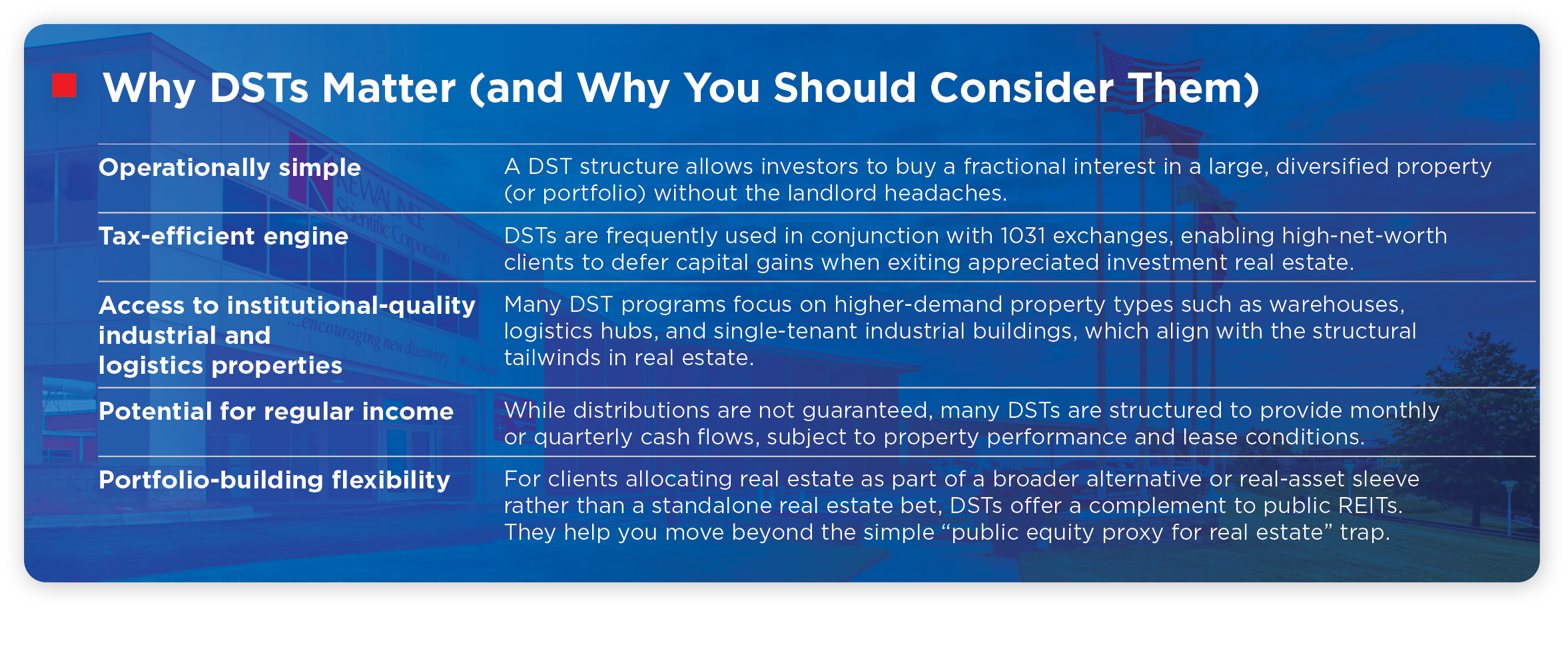
- Operationally simple: A DST structure allows investors to buy a fractional interest in a large, diversified property (or portfolio) without the landlord headaches.
- Tax-efficient engine: DSTs are frequently used in conjunction with 1031 exchanges, enabling high-net-worth clients to defer capital gains when exiting appreciated investment real estate.
- Access to institutional-quality industrial and logistics properties: Many DST programs focus on higher-demand property types such as warehouses, logistics hubs, and single-tenant industrial buildings, which align with the structural tailwinds in real estate.
- Potential for regular income: While distributions are not guaranteed, many DSTs are structured to provide monthly or quarterly cash flows, subject to property performance and lease conditions.
- Portfolio-building flexibility: For clients allocating real estate as part of a broader alternative or real-asset sleeve rather than a standalone real estate bet, DSTs offer a complement to public REITs. They help you move beyond the simple “public equity proxy for real estate” trap.
For advisors, discussing DSTs with clients can help broaden conversations about how real estate fits within a diversified, tax-aware strategy.
A New Approach to Real-Estate Allocation for Clients
Here’s a framework you can share with clients to reposition how they — and you — think about real estate in their portfolio:
- Define the role of real estate.
Is it a diversifier, an income generator, a tax-efficient growth vehicle, or a hedge against inflation? The answer will determine whether you lean public, private, or somewhere in between. - Split the exposure:
- Public REIT: For liquidity, ease of use, and broad real-estate exposure.
- Private real-estate portion: For income stability, lower correlation to equities, targeted sector exposure, and tax-efficiency.
- DSTs and other private alternatives: For clients seeking institutional-style assets, tax-advantaged structures and sector focus (e.g., industrial/logistics).
- Focus on property type and structural tailwinds.
Industrial and logistics are showing resilience and may outperform underleveraged or distressed sectors like retail or older office space (CBRE, 2024). - Be transparent about liquidity and fees.
Private real estate structures, including many DSTs, are less liquid and may carry higher fees. Make sure clients understand the trade-offs. - Manage tax-efficient exits and transitions.
If a client holds appreciated real estate in a taxable account, a DST with a 1031 exchange may align directly with their needs. Position this as part of a broader wealth-transition or tax-deferral strategy, not just as “another property.” - Monitor valuations and market gaps.
With the public–private real estate valuation gap persisting, advisors may want to consider how differences between public-market pricing and private-market appraisals could influence portfolio risk and return considerations (Nareit, 2025).
It's Time to Re-Think Public vs. Private Real Estate
Now may be an appropriate time to reassess how public and private real estate fit within diversified portfolios. Understanding the distinctions between structures, liquidity profiles, and tax implications can help advisors have more informed discussions about allocation preferences.
Disclosure: The material presented is for informational purposes only and should not be construed as investment, tax, or legal advice. Real estate and DST investments involve risk, including loss of principal, illiquidity, and fluctuations in value. Past performance does not guarantee future results. Investors should consult their financial, legal, and tax professionals before making any investment decisions.

Comments