


-
8 min read
Jan 14, 2026 9:47:08 AM

Share On:


Commercial real estate has long been a cornerstone of diversified investment portfolios. However, accessing specific sub-sectors like essential manufacturing real estate in today’s dynamic market can be complicated for individual investors and smaller advisors.
One structure often discussed in this context is Delaware Statutory Trusts (DSTs), which help financial advisors bridge the gap by offering simpler access to institutional-quality, industrial, and manufacturing assets without the operational challenges of direct ownership.
In this article, we’ll explore:
- How DSTs are commonly used to provide access to essential manufacturing real estate.
- Why manufacturing-oriented industrial properties remain relevant.
- How this structure is often considered in long-term, tax-aware planning.
Why Manufacturing Real Estate Matters Today
Industrial properties in the manufacturing space, which include assembly plants, factory space, and facilities tied to broader production ecosystems, have a unique role to play in the commercial real estate landscape.
In 2025, industrial real estate continued to reflect long-term structural demand. According to JLL, demand for manufacturing-related industrial sites–driven by supply-chain reshoring and a need for modern facilities–has increased significantly and now accounts for a meaningful portion of total industrial demand.
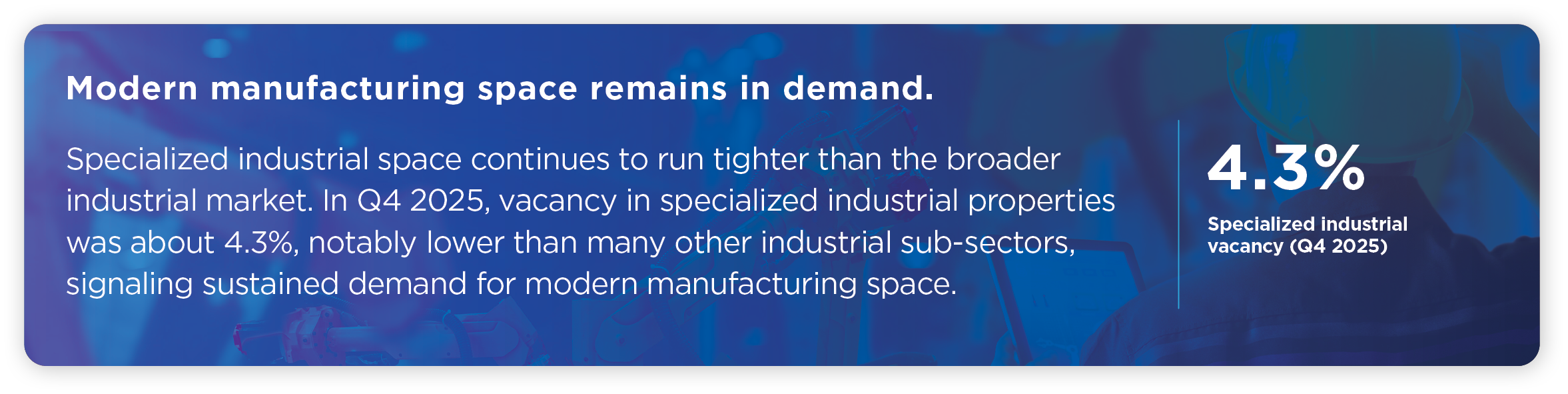
Specialized industrial space, including manufacturing facilities, remains relatively tight compared with broader industrial properties. Recent data for Q4 2025 shows that vacancy in specialized industrial properties was around 4.3% by 2025, notably lower than many broader industrial sub-sectors, which may reflect continued demand for modern manufacturing space.
Taken together, these data points suggest manufacturing-linked real estate continues to be a key driver of industrial market activity, one advisors may want to consider when positioning clients for long-term exposure to real assets.
Barriers to Direct Ownership of Manufacturing Real Estate
Despite the building demand for industrial properties, direct ownership of manufacturing real estate can pose significant challenges for many investors.
- High capital requirements: Industrial manufacturing facilities often cost tens of millions of dollars, well beyond the reach of most individual investors.
- Operational complexity: Direct ownership requires active management of leases, maintenance, tenant relationships, property upgrades, and more.
- Market timing and liquidity risk: Selling or repositioning these assets can take months or years, which doesn’t align with all clients’ liquidity needs.
- Specialized underwriting: Evaluating manufacturing assets demands a deep understanding of industry-specific drivers and risk factors, a niche most financial advisors don’t have time to build in-house.
These barriers often leave advisors looking for a way to give clients exposure to essential manufacturing and industrial properties without the burden of managing ownership responsibilities or sourcing individual assets.
Enter Delaware Statutory Trusts
DSTs – legal entities that allow multiple investors to co-own fractional interests in a professionally managed real estate asset – are commonly used for unlocking access to larger, institutional-grade commercial properties, including manufacturing-linked industrial real estate, in a more passive and accessible way.
For example, DSTs that qualify for Section 1031 exchanges enable investors to defer capital gains taxes when they reinvest proceeds from the sale of appreciated property into like-kind DST interests.
Unlike direct property ownership, DSTs eliminate many operational responsibilities. According to industry sources, DSTs provide passive ownership with no property management duties and are structured to meet IRS guidelines for passive investment compliance in 1031 exchanges.
How Advisors Simplify Access with DSTs

1. Expanding Access to Institutional-Quality Manufacturing Assets
DSTs enable fractional ownership in large, income-producing industrial properties that would otherwise require institutional capital. For example, advisors may evaluate DST offerings with clients that include manufacturing facilities, distribution hubs tied to manufacturing supply chains, or multi-tenant industrial parks strategically located near major transportation infrastructure.
Because DSTs allow multiple investors to pool capital, advisors can deliver exposure to these assets with significantly lower minimum investments compared to direct acquisitions.
This democratization of access enables advisors to discuss strategies that might once have been out of reach for many clients.
2. Streamlined 1031 Exchange Implementation
Helping clients navigate the strict rules of a 1031 tax-deferred exchange is one of the most compelling reasons advisors use DSTs. A typical 1031 exchange requires an investor to identify replacement properties within 45 days and close within 180 days. It can be daunting to find suitable manufacturing or industrial real estate, especially at institutional quality, within that window.
Since DSTs are pre-acquired and pre-vetted, they can serve as a replacement property that already meets structural requirements. In fact, many DST offerings are specifically designed to help investors complete their exchanges before deadlines expire. This can help investors preserve tax deferral while still gaining exposure to a targeted sector of real estate.
3. Passive Income with Professional Management
Manufacturing-related industrial assets may generate stable cash flows, especially with long-term tenants. A DST structure allows investors to receive distribution income without having to manage leases, maintenance, or tenant interactions.
With DST sponsors handling all the day-to-day property management, advisors can discuss DSTs as income-producing, tax-efficient investments with passive ownership, an appealing option for investors who prefer to avoid the operational complexities of direct property ownership.
4. Portfolio Diversification and Risk Distribution
DSTs often include properties in different locations or across industrial sub-sectors, enabling a diversified real estate holding within a single investment vehicle. This capability allows advisors to mitigate risks associated with individual properties or markets.
Diversification through DSTs may be especially valuable when clients are transitioning from concentrated holdings, such as a single warehouse or manufacturing facility, into broader exposure without taking on new operational burdens.
What Advisors Should Consider
While DSTs can offer powerful advantages, advisors should also help their clients think through the trade-offs:
- Liquidity: DST interests are generally illiquid and intended for long-term investment horizons.
- Fees: DST sponsors charge fees that impact net returns, and these vary by sponsor and structure.
- Tax advice: DSTs are complex 1031 exchange vehicles; advisors should coordinate with tax professionals to align with each client’s situation.
The Takeaway
If you’re looking to simplify access to essential manufacturing real estate for your clients, DSTs can offer a combination of fractional access, tax-efficient structuring, professional management, and institutional-quality assets.
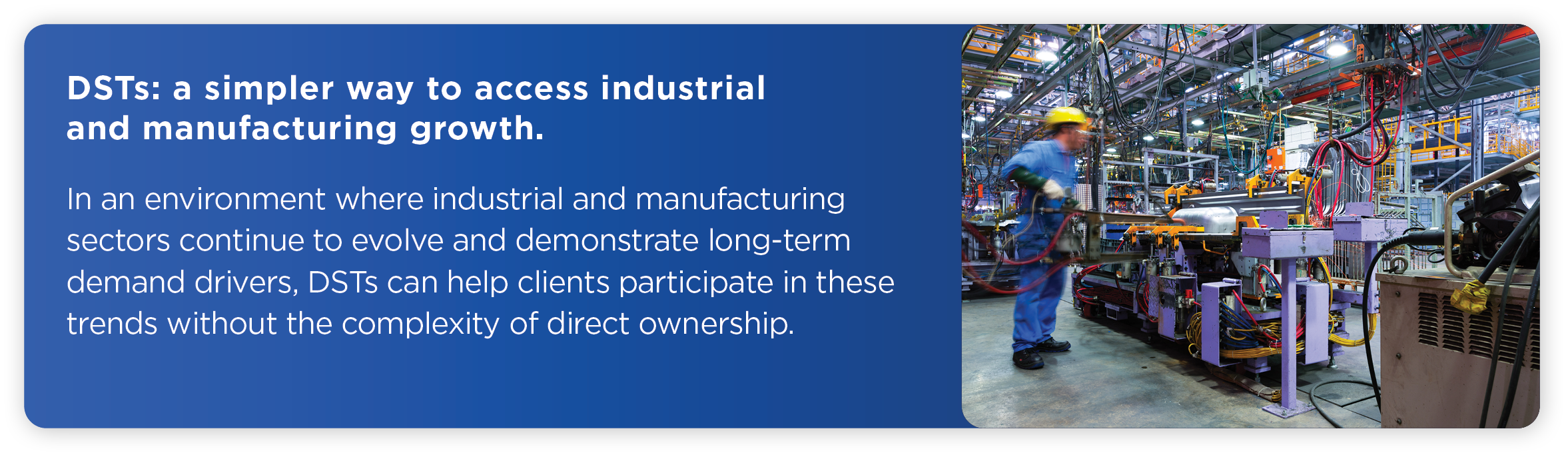
In an environment where industrial and manufacturing sectors continue to evolve and demonstrate long-term demand drivers, DSTs can help clients participate in these trends without the complexity of direct ownership.
Thoughtful integration of DSTs into client portfolios, particularly for investors executing 1031 exchanges or looking for passive real-estate exposure, can help your clients pursue income, diversification, and strategic positioning in a changing real estate landscape.
Disclosure: The information provided herein is for educational purposes only and does not constitute an offer to buy or sell any security, nor should it be construed as investment, tax, or legal advice. Real estate and DST investments involve risk, including loss of principal, illiquidity, and market fluctuations. Past performance and market trends are not indicative of future results. Investors should consult their financial and tax professionals before making investment decisions.
Comments